All roles/Engineering/Hydraulic Systems Technician
Engineering
Hydraulic Systems Technician
You keep the yacht's hydraulic systems working, from passerelles and swim platforms to cranes, stabilisers and steering gear, so guests get their toys on time and the boat stays safe.
- Department
- Engineering
- Reports to
- Chief Engineer
- Yacht size
- 70m+
- Contract
- Permanent or rotation
- Starting pay
- €4,000 per month
What the job is
On a large yacht almost everything that moves runs on hydraulic oil. The passerelle, the side boarding doors, the beach club platform, the tender garage doors, the deck cranes, the anchor windlasses, the stabilisers and the steering gear all depend on pumps, valves, cylinders and hoses. You are the person in the engine department who knows these systems in depth, keeps them maintained and fixes them fast when they fail with guests watching.
Most of the work is planned. You run the hydraulic part of the maintenance schedule in the yacht's planned maintenance system, take oil samples, change filters, inspect hoses and fittings, check accumulator precharge and test relief valve settings. You keep a stock of seals, hoses and spares, and you record every job. The rest is fault finding: a garage door that stalls halfway, a crane slewing slowly, a stabiliser fin alarm at 02:00.
The role exists mainly on yachts of 70m and above, and on refit and new build projects where the systems are complex enough to justify a specialist. You work closely with the deck team, because they operate most of the equipment you look after, and with the ETO, because modern hydraulics are controlled by PLCs and sensors. You stand engine room watches like the rest of the department, and you help with general engineering work when the hydraulics are quiet.
What makes a good one
- Reading hydraulic schematics
- Systematic fault finding
- Hose making and fitting
- Oil cleanliness and contamination control
- Working safely under pressure and load
A day in the life
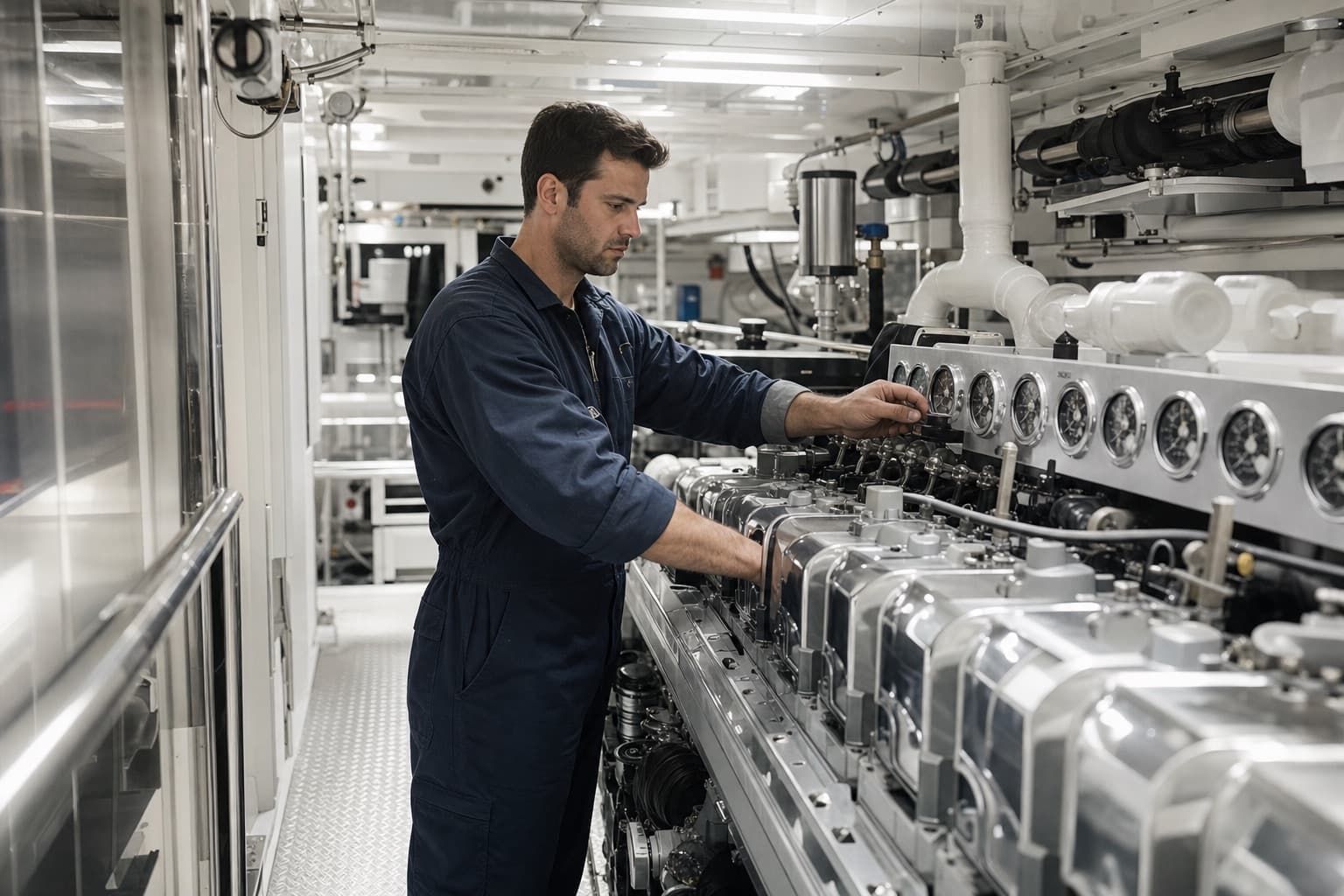
- 07:00Engine room rounds with the duty engineer. You check hydraulic power pack tank levels, oil temperatures and pressures, and look for weeps under the stabiliser and steering gear units.
- 07:45Morning meeting with the Chief Engineer. The deck team reported the port crane slewing slowly yesterday, so it goes to the top of your list.
- 08:15Before guests wake, you open the beach club platform and garage door with the bosun watching. Everything cycles cleanly, so the toys can go in the water on time.
- 09:00Fault finding on the crane. You read the pressure at the slew motor, find the proportional valve sticking, strip and clean it, then test with a light load.
- 12:00Lunch in the crew mess, then you log the crane job in the planned maintenance system and order a spare valve cartridge through the agent in Palma.
- 13:30Planned maintenance on the passerelle: change the return filter, take an oil sample for lab analysis and check the hose dates against the replacement schedule.
- 16:00The guests want the tender back aboard early. You stand by in the garage while the deck crew run the cradle and doors, ready if anything stops.
- 18:00Check accumulator precharge on the zero speed stabilisers, which have been working hard at anchor all day in the swell.
- 20:00Hand over to the night watch with notes on the crane, then you are on call overnight in case a hydraulic alarm needs you.
Pay by country
Monthly salary for yachts of 70m+, usually paid in EUR or USD whatever the flag. Rotational contracts often pay a little more. Charter tips are shared with the whole crew on charter yachts and can add a month's salary or more each season.
- France and Monaco
- €4,000 – 5,500
- Spain
- €4,000 – 5,500
- Italy
- €4,000 – 5,500
- United Kingdom
- £3,400 – 4,700
- USA (Florida)
- US$4,300 – 6,000
- Caribbean
- US$4,300 – 6,000
- UAE
- AED 16,000 – 22,000
- Australia
- A$6,500 – 9,000
- New Zealand
- NZ$7,200 – 9,900
Required
- STCW Basic Safety Training
- ENG1 medical
- PDSD
- AEC 1
- Trade qualification in hydraulics or mechanical engineering
Recommended
- AEC 2
- MEOL (Yacht)
- IFPS Fluid Power certification
- Manufacturer hydraulic training
- Advanced Fire Fighting
- Y4
Visas
- Schengen visa
- US C1/D
- US B1/B2
Where it leads
- Mechanical Technician
- Hydraulic Systems Technician
- Third Engineer
- Second Engineer
- First Engineer
- Chief Engineer
Hydraulic Systems Technician jobs open now
Questions crew ask
Do I need yacht experience to get this job?
Not always. Captains and Chief Engineers often hire technicians from offshore, industrial or shipyard hydraulics, as long as you have your STCW, ENG1 and a solid trade background. Expect to learn yacht routines quickly once aboard.
Will I only work on hydraulics?
No. Hydraulics come first, but you stand engine room watches and help with general mechanical work, bunkering and refit jobs. Taking AEC and MEOL tickets makes you more useful and more employable.
Can this role lead to a Chief Engineer position?
Yes, if you build sea time and work through the MCA Yacht engineering tickets from Y4 upwards. Many technicians move into Third Engineer roles once they hold MEOL (Yacht) or Y4.